

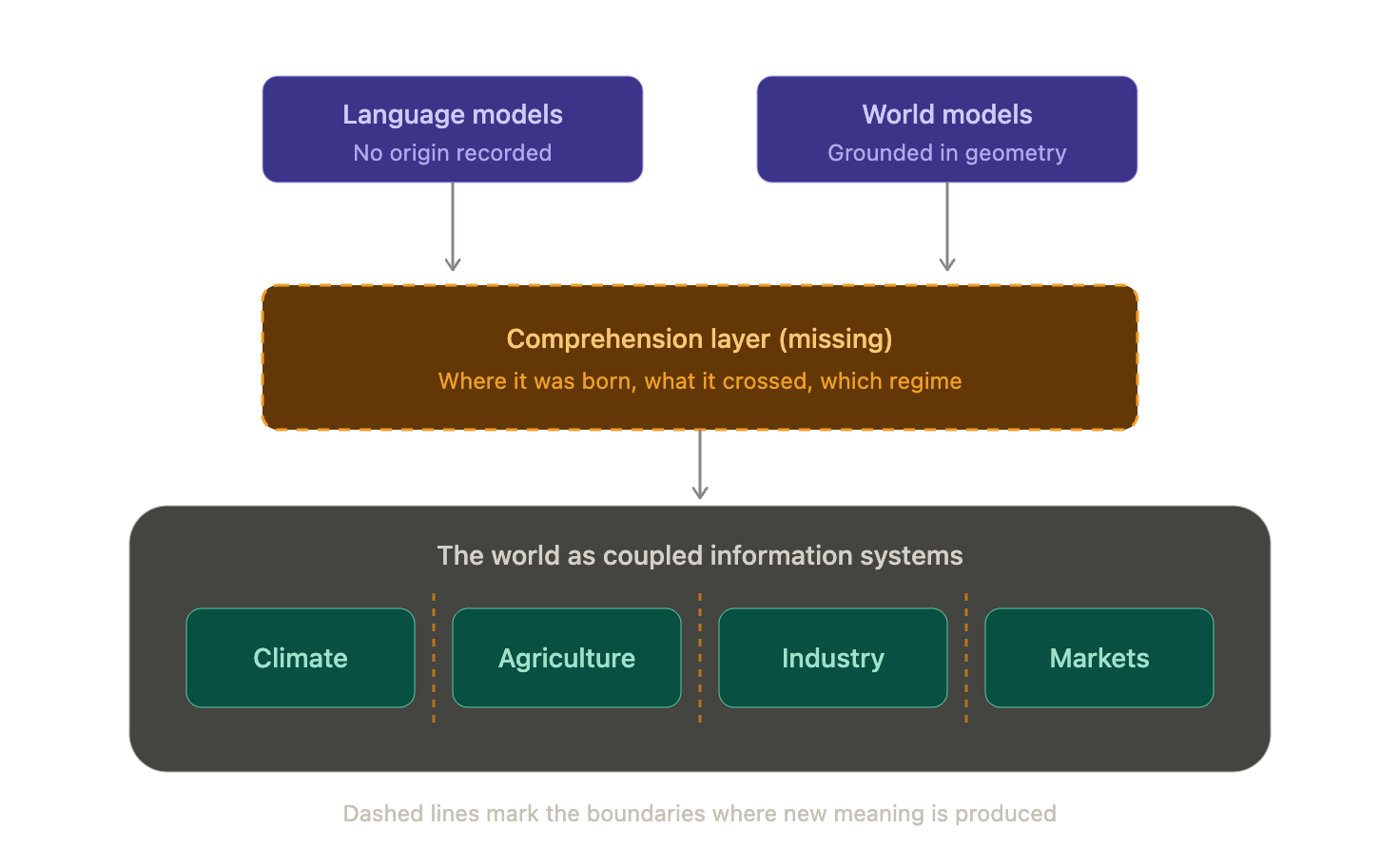
The frontier of AI is rediscovering something the complexity, spatial and network sciences have known for a long time: you cannot reason correctly about a system whose generative context you cannot perceive.
The capital flows tell you how seriously that claim is now being taken. Fei-Fei Li’s World Labs has raised over a billion dollars on spatial intelligence and has already shipped a product. Yann LeCun left Meta and raised over a billion at a multiple of that valuation before releasing anything at all. Genie, Cosmos, Marble, V-JEPA. Whatever else this constitutes, it is not an argument about layer counts. It is an argument about epistemology, conducted with venture capital.
But the debate as it is actually being held is an argument about representation. Pixels or latents. Tokens or meshes. Generate the world or predict it in embedding space. Those are real distinctions; however, they are not where the binding constraint sits. The constraint is provenance, and today neither camp has a theory which addresses the topic.
What follows is a proposal for the organizing system that does: Information Ecology.
From industrial ecology to information ecology
In the mid-1990s, Graedel and Allenby did something to industrial systems that to some looked like a metaphor, but in reality it turned out to be a method. They stopped treating a factory as a machine that produced goods and started treating it as an organism inside a metabolism - stocks, flows, residuals, life cycles, trophic exchange with the firms around it. Nothing about the physical plant changed. What changed was what became visible and tangible: byproduct symbiosis, where embodied energy actually accumulated, where a substance really ended up after it left the gate.
That is the test of an organizing system. It is not just a more pleasant way of describing what you already knew. It makes a class of question askable that was previously unaskable, and then the answers arrive.
Allenby’s later work with Chester sharpens the point in a way that transfers directly. 21st century infrastructure has decoupled from the conditions it was designed for in the 20th century. The design assumptions might be stable, but the environment, along with embedded shifting baselines, is not. Our data infrastructure sits in exactly that position today. It was built under measurement scarcity and expensive storage (remember when server farms were the limiting factor?). We now operate under measurement abundance and effectively free storage, and we are still running pipelines whose first act is to discard the context that made the measurement mean anything.
Industrial ecology reframed material throughput. Information ecology reframes informational throughput. The move is the same, and it is available now for the same reason it was available then: the accounting we inherited was designed for a world that no longer exists.
Ontogeny is the life history. Ecology is the system of life histories.
I have evolved five versions of a working paper on information ontogeny - the developmental history of a single information asset. Where it was born. What it came into contact with. When it matured into actionability. How, and how fast, it decays. The claim there is that this history is not metadata appended to the observation; it is constitutive of what the observation means.
Ontogeny is the individual, and ecology is the population, the community, the ecosystem. Promoting the frame one level up is what turns a claim about meaning into an organizing system for generating knowledge. A handful of constructs do most of the work.
Niche. A dataset does not answer questions in general. It occupies a niche of questions it is structurally competent to answer, bounded by how it was generated. A great deal of analytical failure is simply a dataset deployed outside its niche, performing confidently in a habitat it was never fit for.
Grain and extent. Field, county, watershed, nation, continent. Each level of aggregation is a different organism, not a coarser view of the same one - different couplings, different maturity window, different decay rate. Grain and extent should be set by the decision the information will inform, and never by what happened to be available.
Ecotone. In ecology, the transition zone between two communities carries the highest generative activity. The same holds here. Climate into agriculture. Agriculture into pharmaceutical inputs. Physical into digital. These boundaries are where new meaning is produced, and they are also where mispricing concentrates, for a boring institutional reason: no single discipline is accountable for a boundary, so no single discipline monitors one.
Keystone data. Some assets carry a disproportionate share of the inference in a system. Remove them and an entire community of downstream conclusions collapses - not degrades, collapses. We are currently running an uncontrolled experiment on this as long-run observational programs are defunded and dismantled. The loss is not one time series. It is every coupling for which that series was the only available bridge.
Trophic transfer. Raw observation becomes derived index becomes composite indicator becomes decision input. Something is lost at every transfer, irreversibly. Aggregation is metabolic, not free, and the loss is rarely accounted for anywhere.
Niche construction. Organisms modify the environments that shape them. So do measurements. When a satellite-derived signal is executed on algorithmically within minutes, the observation has stopped describing the phenomenon and started participating in it. The physical-digital boundary is the fastest-evolving ecotone currently active, and the least well characterized.
Alternative stable states. Complex systems reorganize, and they do it before their output statistics look anomalous. Skill is a property of the regime, not of the model. Any accuracy figure reported without the regime it was earned in is an ecological error wearing a statistical costume.
Why the reframe generates knowledge rather than describing it
César Hidalgo’s argument in Why Information Grows is the load-bearing piece here. Information is physical order. It requires out-of-equilibrium systems to arise, solids to persist in, and computation to grow. And knowhow accumulates in networks of people rather than in individuals, bounded by what one person can hold and what one firm can coordinate.
Economies grow their knowledge by growing structures capable of holding it.
Carry that across and you get a corollary that is direct and should be uncomfortable for anyone selling models. If knowledge capacity is a property of network structure, then more model does not buy you more knowledge. You buy knowledge by changing the network: adding a coupling, instrumenting a boundary, preserving a provenance channel that was previously discarded, putting a person at an ecotone who can read both sides of it.
That is what makes the ecological frame generative rather than decorative. It tells the user where to spend.
The ecology is already becoming operational
Werner Vogels predicted that open data would drive decentralized disaster preparedness - hyperlocal, community-sourced observation shifting resilience from a top-down reactive posture to a distributed one. Read in this frame, that is not a data-management prediction. It is an ecological one. Distributed sensing does not win on resolution alone. It wins on diversity, redundancy, and locality, which are the properties that make ecosystems robust to shocks that take out any single component.
His prediction about interdisciplinary cooperation and the polymath practitioner is the human-capital version of the ecotone claim. The productive work is at the boundaries, and the scarce input is people who can stand at one without falling over.
And there is also something quieter worth noting. Vogels spent a career on distributed systems, where you design for partial failure as a first assumption rather than a contingency. That is already an ecological posture toward information. It just hasn’t been named as one.
Two examples from my own portfolio
Frameworks are cheap. Here is what this looks like when it costs you something.
Bridge Horizon is a climate-macro forecasting system built on slow boundary conditions as precursors to cross-asset outcomes. The single most useful result of the past year was a null. Weekly observed temperature carries no forward information for month-ahead degree days. None that survives correction for multiple comparisons. Predictability lives in the slow boundary conditions - ENSO state, sea surface temperatures, wave propagations, etc. - and not in recent local weather, however intuitive the opposite feels.
In the conventional framing, that is a failed feature and an embarrassing paragraph. In the ecological framing it is a finding about where in the system predictive information is generated, and at what grain. It changed what we instrument and what we stopped paying for.
Second, skill in that system is regime-conditional: widest in volatile La Niña states, compressed in calm El Niño states. The environment sets the carrying capacity of the signal, which is not a caveat to bury in an appendix. It turns out that it is the primary result.
Third, and least comfortable: a leakage flaw in the walk-forward architecture invalidated a set of previously published results. We found it, corrected it, and republished the corrected picture - energy retained a modest edge, agriculture and metals did not survive the correction. The ecological reading is that validation architecture is part of the habitat. If your test environment is not the environment the model will actually live in, you have measured fitness in a greenhouse and reported it as fitness in the wild.
MLR-ARX was built for gas-storage nowcasting, and the interesting turn was not a performance gain. It was repositioning the method from a forecasting tool to a structural attribution engine. In the spatial version, the deliverable is not a number. It is the coefficient field across locations - a map of where a coupling is strong, where it inverts, where it dissolves entirely. That is a picture of the ecology, and it is a kind of object a point forecast can never be, no matter how accurate.
The debate: LLMs, world models, and the layer both are missing
LeCun’s argument is that text-trained systems are ungrounded by construction - they can discuss physics without perceiving it - and that the path runs through learned representations of dynamics, prediction in latent space, and planning. Li’s argument is that spatial intelligence is the scaffolding on which cognition is built, that reasoning is downstream of perception, and that the way to demonstrate this is to ship systems that reconstruct and generate three-dimensional space. The internal distinctions matter too: renderers that output pixels, simulators that output physical state, and planners that output actions are three different animals, and conflating them is the most common error in the coverage.
Here is what both camps share, and where an ecological frame has something to contribute.
A model grounded in geometry and physics is grounded in structure. It is not thereby grounded in provenance. These are different commitments. A simulator can be physically impeccable and ecologically naive - correct physics, wrong regime, no representation of the fact that the configuration it learned in has since reorganized. The sim-to-real gap is usually described as a fidelity problem, but I believe that it is better described as an ontogenic one. Simulated data and real data can be numerically indistinguishable while having been born through radically different generative processes. That gap closes when synthetic data carries a synthetic provenance, and nobody has built that yet.
And the LLM side is not simply the losing party here. Language models are the best boundary-crossing instrument anyone has ever built. The reason a temperature anomaly can be read as a constraint on global physical supply is that someone holds the vocabulary of both systems at once - and translation across ecotones is exactly what these systems are extraordinary at. What they cannot do is tell you where the value came from. They inherit whatever context survived preprocessing, which is typically none of it.
So the honest read is not that world models beat language models, nor is it the reverse. It is that both are perception-and-representation layers sitting on top of a missing comprehension layer: the durable record of where information was born, what it passed through, how fast it travels, and which regime it belongs to. Today, neither pixels nor tokens carry that. It has to be built on purpose, with intention, and it is mostly a data-engineering and epistemic-discipline problem rather than a foundational scientific modeling one - which is exactly why it is being skipped.
I am not a fan of forecasting future technological trends, but there is one prediction I will stand behind. The most useful world models of the next several years will not be trillion-parameter renderers. They will be small(ish), domain-bounded, observationally grounded models - living on the first two rungs of Pearl’s hierarchy (the ladder of causation) - that are explicit about their regime and preserve the provenance of their inputs. There will be thousands, most of them unglamorous, and the good ones should (will) be distinguished from the bad ones as much by context preservation as they are by skill.
How to actually work this way - information for practitioners
Inventory information systems, not datasets. Ask what generative process produces this, at what scale, with what coupling pathways - not what table it lives in.
Locate the boundary layers, then instrument them. The boundaries nobody owns are where the findings are.
Set grain and extent from the decision backwards. Never from data availability forwards.
Identify your keystone assets and price their loss before you lose them. Including the public observational infrastructure you have been treating as free.
Estimate developmental velocity, not statistical lag. Lead time should come from a characterized mechanism, because a mechanism survives reorganization and a correlation does not.
State the falsification condition. If you cannot say what would show the coupling to be wrong, you have a narrative rather than a framework.
Closing
Industrial ecology was never a metaphor. It was a change in the unit of account that made a generation of findings possible. Information ecology is the same kind of move, applied to the substrate that everything else now runs on - data.
The most consequential analytical failures of the past decade were not failures of data volume, compute, or domain expertise. They were failures of context. The structural conditions were legible in the developmental history of the relevant information systems - in their topology, their couplings, the concentration of their generative sites - and that history was not examined, because the frameworks in use treated data as inventory rather than as something with a life.
Knowledge is created at the boundaries. Build the systems that can see them.
Referenced and adjacent work
Oyama, S. (1985/2000). The Ontogeny of Information: Developmental Systems and Evolution. Duke University Press.
Graedel, T. E. & Allenby, B. R. Industrial Ecology; Industrial Ecology and Sustainable Engineering (2010). The founding reframe this piece builds on.
Allenby, B. R. & Sarewitz, D. (2011). The Techno-Human Condition. MIT Press. See also Chester & Allenby on infrastructure decoupling from design conditions.
Hidalgo, C. (2015). Why Information Grows: The Evolution of Order, from Atoms to Economies.
Vogels, W. Tech Predictions for 2025 and Beyond (”Open data drives decentralized disaster preparedness”) and for 2026 and Beyond (”the renaissance developer”). All Things Distributed.
Li, F.-F. (2025). From Words to Worlds: Spatial Intelligence is AI’s Next Frontier. World Labs; and the World Labs taxonomy essay (June 2026).
LeCun, Y. Joint Embedding Predictive Architecture (JEPA) and the AMI Labs thesis.
Ferrari, M. (2026). Information Ontogeny as Infrastructure, Working Paper v5 / v6. Atlas Research Innovations.
Ferrari, M. The Spatial Frontier of AI. LinkedIn.
Liu, J. et al. (2013). Framing sustainability in a telecoupled world. Ecology and Society 18(2).
Meadows, D. (2008). Thinking in Systems.